Supporting Children, Teens, and Adults with Insight and Clarity
Whether you’re a parent noticing your child’s struggles with focus, a teen overwhelmed by school demands, or an adult facing challenges with organization, time management, or follow-through, an accurate and thoughtful assessment can make all the difference.
At Arcadian Therapeutic Services, we provide comprehensive ADHD and executive functioning evaluations that offer more than a diagnosis—they offer a roadmap to meaningful support.
What the Evaluation Involves
Each assessment includes:
A semi-structured clinical interview exploring attention, impulsivity, working memory, and emotional regulation
Behavioral observation in session
Computerized attention testing that measures attention directly, alongside what others report
When applicable, multi-rater reports gather input from parents, loved ones, teachers, and the individual
Use of updated, evidence-based tools to support accurate results and helpful recommendations
Assessment Tools We Use
For Children and Adolescents
Conners Early Childhood™ (Conners EC™) – Measures behavioral, social, and emotional development in young children (ages 2–6)
Conners Kiddie Continuous Performance Test™ 2nd Edition (Conners K-CPT™ 2) – Computerized picture-based task measuring attention in young children (ages 4–7)
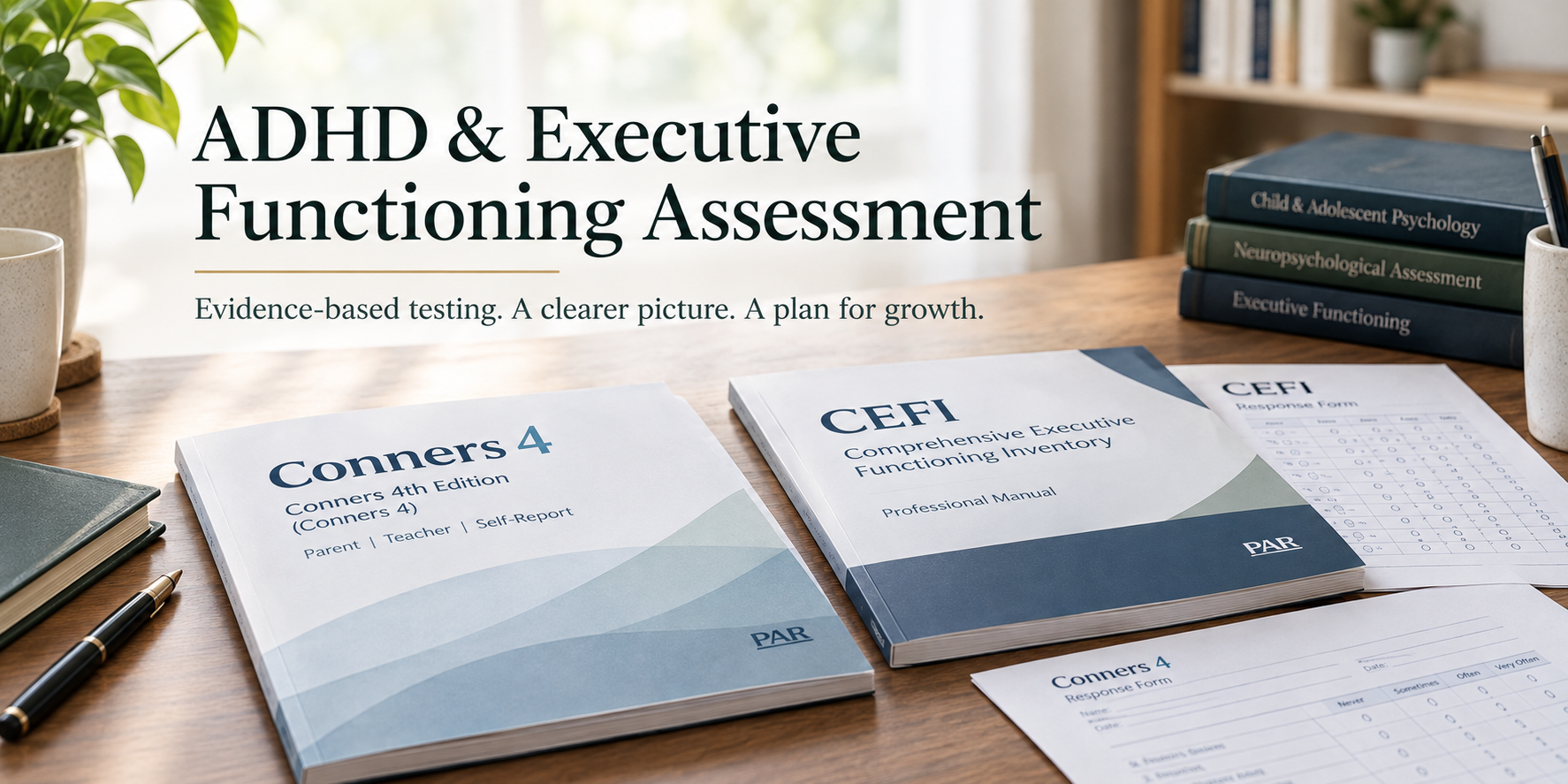
Conners 4th Edition (Conners 4®) – Measures ADHD symptoms and related behavioral challenges (ages 6–18)
Vanderbilt ADHD Diagnostic Rating Scales – Parent and teacher reports on ADHD symptoms, school performance, and commonly co-occurring concerns (ages 6–12)
Comprehensive Executive Function Inventory (CEFI®) – Assesses executive functioning strengths and challenges (ages 5–18)
Conners Continuous Performance Test™ 3rd Edition (Conners CPT™ 3) – Computerized task measuring visual attention, impulsivity, and vigilance (ages 8+)
Conners Continuous Auditory Test of Attention® (Conners CATA®) – Computerized task measuring auditory attention and processing (ages 8+)
For Adults
Conners Adult ADHD Rating Scales, 2nd Edition (CAARS™ 2) – Measures ADHD symptoms in adults with DSM-5-aligned scoring (ages 18+)
Comprehensive Executive Function Inventory Adult (CEFI Adult™) – Evaluates executive function challenges and strengths in adults (ages 18+)
Conners Continuous Performance Test™ 3rd Edition (Conners CPT™ 3) – Computerized task measuring visual attention, impulsivity, and vigilance (ages 8+)
Conners Continuous Auditory Test of Attention® (Conners CATA®) – Computerized task measuring auditory attention and processing (ages 8+)
Adult ADHD Self-Report Scale (ASRS v1.1) – An 18-item screening questionnaire developed with the World Health Organization, used alongside the clinical interview (ages 18+)
Support Beyond the Diagnosis
Turning Assessment Results Into Practical Strategies for Everyday Life
An assessment should do more than identify areas of difficulty—it should provide a clear path forward.
Our evaluation process translates assessment findings into individualized, practical recommendations for home, school, work, and therapy. When the CEFI identifies areas of executive functioning that may be impacting daily life, you will receive research-informed resources specifically matched to those areas of need.
Research-Informed Support for Executive Functioning
Based on the areas of executive functioning identified through the CEFI, you will receive individually selected handouts addressing the specific skills that may be interfering with learning, work, relationships, or daily functioning.
These resources are personally developed and regularly updated using current research. They are designed to provide practical strategies that can be implemented—not only by the individual, but also by the people supporting them.
Resources may be used by:
You or your child at home to build and practice executive functioning skills
Teachers and school staff to support learning and classroom functioning
Therapists and other providers to incorporate targeted strategies into ongoing treatment
Parents and caregivers to create consistent supports and routines
Adults in the workplace or academic settings to improve organization, time management, attention, and follow-through
From Assessment to Action
Rather than simply telling you where difficulties exist, we help identify what can be done about them.
Your recommendations are connected to the findings from your evaluation and may address areas such as organization, planning, time management, attention, emotional regulation, working memory, and other executive functioning skills.
The goal is to give you concrete tools that can be used across settings and by the people involved in your ongoing support.
What You Receive
After the evaluation, you will receive a comprehensive written report that includes:
Diagnostic findings and symptom profiles
Observations and assessment results
Functional impact on learning, work, relationships, and daily life
Research-informed handouts targeted to the executive functioning areas identified in your evaluation
Practical strategies for use at home, school, work, and/or in therapy
Individualized recommendations for accommodations and support
Letters supporting accommodations, when appropriate and requested
Recommendations for next steps and coordination with other professionals
A More Useful Kind of Assessment
The goal isn't simply to give you a diagnosis. It's to help you understand how you function, identify what is getting in the way, and provide practical tools to move forward.